(W.E. Talk) Zheng Yongnian: Why does China offer the world “another institutional choice”?
ECNS-Since the launch of reform and opening-up,China has developed from a poor and underdeveloped nation into the world’s second-largest economy and largest trading country.Its per capita GDP has risen from under US$300to over US$12,000,with a middle-income group now exceeding400million people.Since the18th National Congress of the Communist Party of China (CPC),nearly100million ruralpoverty stricken peoplehave been lifted out of poverty,creating multiple miracles in the history of world economic development.
In sharp contrast,some countries today are mired in governance crises,with intensifying social conflicts and great political and economic uncertainty.Why does such a contrast exist?Why is it said that China provides the world with“anotherinstitutional choice”?China News Service’s“W.E.Talk”interviewed Zheng Yongnian,Dean of The Institute for International Affairs,Qianhai under the Chinese University of Hong Kong,Shenzhen,and Chairman of the Academic Committee of the Institute of Public Policy at South China University of Technology.
Below is an excerpted transcript of the interview:
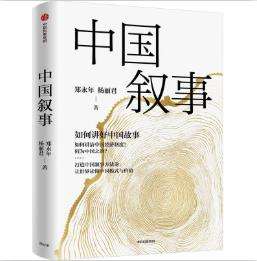
CNS:In your bookChinese Narration:How to Tell the Good Story of Chinayou mention that the contrast between the problems faced by the West and China’s sustainable rise has triggered Western fear of China’s economic system.In the same wave of globalization,why doessuch a contrast emerge?Is China’s system truly“fearsome”?
Zheng Yongnian:This primarily lies in governance issues within the West itself,that is to say,itswidening income inequality leadsto highly divided societies.Globalization enablesrelatively free flows of capital,technology,and talent worldwide.Some Western countries,especially the UK and the US,reap enormous wealth from it.Yet only a very small number of citizens captured the vast majority of the benefits,while much of the middle class gained little.Since the1980s,America’s middle class has been shrinking,dropping from about65%of the population to around50%today.
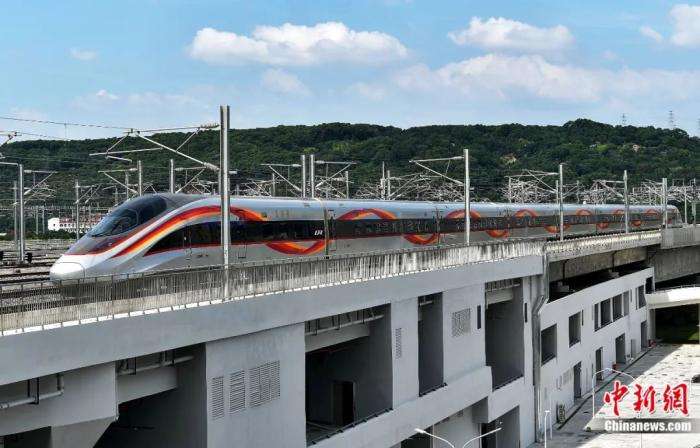
Fuxing EMU runs on theFuzhou-Xiamen-Zhangzhou High-speed Railway Line. (CNS)
In fact,globalization affected China as well,but ourinstitutionhad unique advantages.Since reform and opening-up,China has grown from a poor country into the world’s second-largest economy,lifting over800million people out of poverty in just40years.Today,our middle-income group exceeds400million.While globalization has influenced income inequality,we relied on systemic advantages and targeted poverty alleviation to ensure basic social fairness.
China is one of the few countries since the1980s to achieve three forms of sustainable development simultaneously:sustainable economic growth,sustainable social stability,and sustainable political institutional support and leadership.Advancing in all three areas—and projecting them internationally—has generated a“sense of fear”among some Western countries.To be fair,Western economies and technologies are still advancing,but the problems caused by unfair distribution remain unresolved.
CNS:In recent years,some Westerners have labeled China as“state capitalism”.Why is this view untenable?
Zheng Yongnian:Since modern times,most countries have exhibited some form of state capitalism,with governments assuming certain roles in economic development—the only difference is the extent of intervention.The United States,in fact,is also a kind of state capitalism.For instance,from1945to1970,Keynesianism advocated state intervention in the economy.TheformerBiden administrationalsointervenes in economic affairs.Compared with the US,China has one more tool of intervention—state-owned enterprises(SOEs).While the USdoes not haveSOEs,it still implements industrial policy through its military-industrial complex.
Some Westerners simplistically label China as“state capitalism”mainly because of China’s rapid economic growth,perceiving it as a threat.There is an ideological factor at play.Historically,the concept of“state capitalism”was first proposed by Lenin,referring to planned economies in which only state-owned capital existed.But in China,alongside state-owned capital,there are also private enterprises,which contribute what is often summarized as“56789” (more than50%of tax revenue,60%of GDP,70%of technological innovation,80%of urban employment,and90%of enterprises in number).
In fact,China has maintained a mixed economy for thousands of years.Chinese civilization integrated private and public ownership very early.The ancient well-field system is a case in point:a“well”(a unit of land in this system,in shape of Sudoku)covered900mu(a traditional Chinese unit of area,one mu equals666.67square meters),which was divided equally into nine plots of100mu each. The central square was public land,while the surrounding eight were private.This combined both public and private elements.
CNS:In your book,you mention that unlike the Western separation of politics and economics,in China,the economy has always been an effective tool of governance.What kind of“anotherinstitutional choice”does China provide?
Zheng Yongnian:In the West,since modern times,with the rise of capitalism,the economy gradually separated itself from other social domains and from society itself.This ultimately evolved into today’s neoliberal economics,emphasizing economic autonomy and opposing government intervention.The separation of politics and economics is both a source of Western economic development and of social problems.
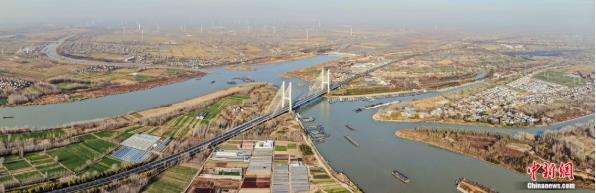
Cargo ships travel along the Grand Canal in Huai'an,Jiangsu Province. (CNS)
In East Asian civilizations—whether China,South Korea,or Singapore—economic activity has always been defined as an integral part of government responsibility.Throughout Chinese history,the state consistently bore responsibility for managing the economy.The story of The Great Flood of Gun-Yu,the Grand Canal flowing through history,and today’s“calling card”of high-speed rail all reflect this tradition.China’s rapid rise in recent years,along with its massive infrastructure projects,further proves the effectiveness of China’s system.
Today,Western capitalism faces problems of oversized capital and imbalance between government and market.The core solution is to handle the relationship between government and market properly.The West is also reflecting on its own system.Although still within the framework of capitalism,the essence of“Bidenomics” places more emphasis on the government’s role—protecting vulnerable groups and the middle class through various measures.Even in American society,there are growing calls for government action.
Thus,when we describe China’s economic system in terms of how the government manages the government-market relationship,we are presenting“anotherinstitutional choice”.This is not about replacing the Western system,but about offering the world an additional reference.
CNS:Since modern times,China has increasingly interacted with and integrated into the global economy,becoming part of it.How should we understand the phrases“world solutions to China’s problems”and“China’s solutions to world problems”?
Zheng Yongnian:This is an enduring issue.Ever since modern China came into contact with the Western-dominated global system,both“world solutions to China’s problems”and“China’s solutions to world problems”have existed.
After the fall of the Qing Dynasty,progressive Chinese intellectuals sought truth from the West,experimenting with Western-style multi-party systems,presidential systems,and parliamentary systems.After repeated failures,they sought new models.The October Revolution in Russia introduced Marxism-Leninism to China,which directly led to the founding of theCPC.Thus,the very founding of theCPCwas itself a“world solution to China’s problems”.Similarly,China’s accession to the WTO in2001was another case of seeking solutions from the world.
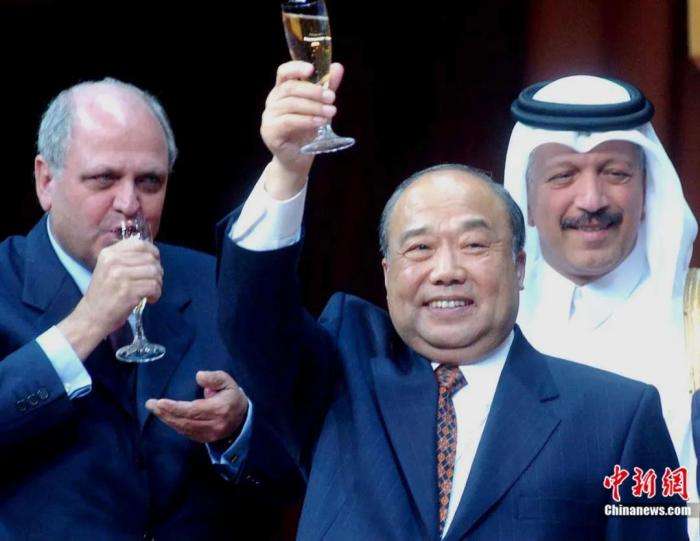
On November12,2001,the signing ceremony for the China’s accession to the WTO Protocol was held in Doha,the capital of Qatar.At the signing ceremony,thenChineseMinister of Foreign Trade and Economic Cooperation Shi Guangsheng,along with representatives from various countries,raised their glasses to celebrate. (CNS)
For much of modern history,China followed the path of“world solutions to China’s problems”.But in recent decades,especially since reform and opening-up,as China has risen rapidly,“China’s solutions to world problems”have become an emerging trend.For example,poverty eradication is both a Chinese and a global challenge,and China has put forward the idea of“common prosperity”.Other examples include the Belt and Road Initiative and the concept of Chinese modernization.
It is worth noting that in the case of“world solutions to China’s problems”,China never simply copied other countries’experiences,but emphasized“the sinicization of world approaches”.Likewise,in“China’s solutions to world problems”,China does not impose its own models,logic,or institutions on others,but merely offers a choice.
This is linked to the nature of Chinese civilization.It is an inclusive,secular civilization that values harmony without uniformity.At the same time,it possesses continuity—it can absorb and digest the strengths of other civilizations,transforming them into part of its own,ensuring its vitality through constant renewal.(End)
Profile of the Interviewee:
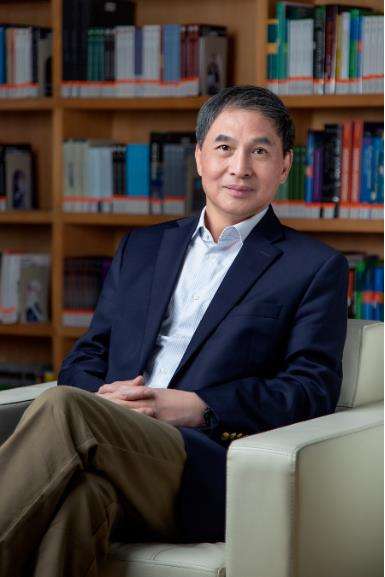
Zheng Yongnian is Dean ofThe Institute for International Affairs,Qianhai at the Chinese University of Hong Kong,Shenzhen;Chairman of the Guangzhou InstituteofGBA;Editor-in-Chief of The Asian Review of Political Economy(ARPE)under Springer-Nature;andEditor-in-Chief of the China Policy Series under Routledge;and Co-Editor of the Series on Contemporary China under World Scientific.
His research mainly focuses on international relations,foreign policy,China-U.S.relations,as well as China’s internal transformation and its external relations.In recent years,he has successively publishedandedited nearly100works,including more than10monographs in English.He has also published dozens of academic papers in international academic journals.